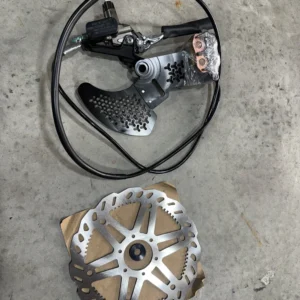


Talaria Sting Pro TL5500 Rear Brake Assembly.
The Talaria Sting Pro TL5500 rear brake assembly 2026 is a high-performance hydraulic disc system engineered to deliver reliable, fade-resistant stopping power across Australia’s demanding off-road terrain—from steep fire-trail descents to technical singletrack. Featuring a 220mm rotor, OEM dual-piston caliper, and DOT-compatible hydraulic lines, this assembly ensures precise modulation and consistent braking under load, making it essential for safety and control on the 72V Sting Pro chassis.
Rear Brake Specifications and Compatibility
The TL5500 rear brake system is designed specifically for the Sting Pro MX5 platform, integrating seamlessly with the bike’s frame-mounted caliper bracket and rear wheel hub. Key specifications include:
-
Rotor Diameter: 220mm (OEM), 3mm thickness
-
Caliper Type: Hydraulic dual-piston (OEM), compatible with front or rear mounting
-
Brake Fluid: DOT 4 or DOT 5.1 hydraulic fluid
-
Mounting: Direct bolt-on to factory frame tabs (M6x68mm), no adapters required for OEM setup
-
Pad Compatibility: Semi-metallic OEM pads; aftermarket copper-sintered or high-temp upgrades available
-
Line Type: Steel-braided hydraulic hose (OEM); upgraded PTFE-core lines available for performance kits
The rear brake assembly is compatible with all Sting MX5 (TL5500) models, including L1e road-legal variants. It is not interchangeable with 60V MX3/MX4 rear hubs without modification, as rotor mounting patterns and caliper alignment differ between generations.
Performance and Safety Features
For Australian riders, the TL5500’s rear brake plays a critical role in controlling speed, maintaining traction, and preventing rear-wheel lockup under hard braking. The 220mm rotor provides ample leverage for the dual-piston caliper, ensuring strong initial bite and progressive modulation without excessive lever effort.
The hydraulic system’s sealed design resists contamination from dust, mud, and water—common challenges across Australia’s off-road environments. DOT 4/5.1 fluid offers high boiling points, reducing the risk of brake fade during repeated hard stops on long descents or in hot conditions.
OEM semi-metallic pads provide a balance of longevity and consistent performance for trail riding, while aftermarket copper-sintered pads (operating up to 540°C) are recommended for aggressive enduro, downhill, or high-load applications.
Upgrade Options and Customisation
Australian riders seeking enhanced rear braking performance have several proven upgrade paths:
-
Sur-Ron Ultra Bee Caliper Kits: Direct bolt-on replacement using genuine 2-piston Ultra Bee calipers and master cylinders, paired with 220mm or 230mm floating rotors for improved heat dissipation and stopping power.
-
Dual-Caliper Rear Brake Kits: Two Ultra Bee calipers mounted on a single rotor—one actuated by the hand lever, the other by a foot-brake pedal—allowing independent rear braking control for technical terrain or wheelie modulation.
-
High-Performance Rotors: Upgraded 220mm or 230mm floating rotors (3.5mm thick) with cooling grooves and heat-treated 420J2 stainless construction for superior fade resistance.
-
Steel-Braided Lines: PTFE-core, stainless-steel-braided hydraulic hoses reduce line expansion under pressure, improving lever feel and consistency.
-
Moto-Style Foot Brake Conversions: CNC-machined 7075 aluminium pedals with Nissin master cylinders for motocross-style rear braking control.
All major upgrade kits utilise the TL5500’s factory mounting points, requiring no drilling or fabrication—though some frames may need 0.5–1.5mm shim washers for perfect caliper alignment.
Maintenance and Longevity
To ensure optimal rear brake performance and safety:
-
Inspect brake pads regularly; replace when total thickness reaches 2.0mm (minimum spec).
-
Check rotor for warping, scoring, or excessive wear; replace if thickness falls below 2.5mm.
-
Bleed the hydraulic system annually or if lever feel becomes spongy, using only DOT 4 or DOT 5.1 fluid.
-
Clean caliper pistons and slide pins during pad changes to prevent sticking or uneven wear.
-
Verify caliper alignment after wheel removal or impact; misalignment causes premature pad wear and reduced braking efficiency.
Riders carrying additional gear or tackling steep, technical terrain should consider high-temp pads and floating rotors to maintain consistent performance under load.